GRAECOPITHECUS: UNA HISTORIA DEL LADO NORTE
Graecopithecus freybergi (von Koenigswald, 1972)
Superfamilia: Hominoidea

Familia: Hominidae
Dryopithecidae
Subfamilia: Homininae
Dryopithecinae
Ponginae
Tribu: Hominini
Graecopithecini
Dryopithecini
Sivapithecini
Lufengpithecini
.jpg)


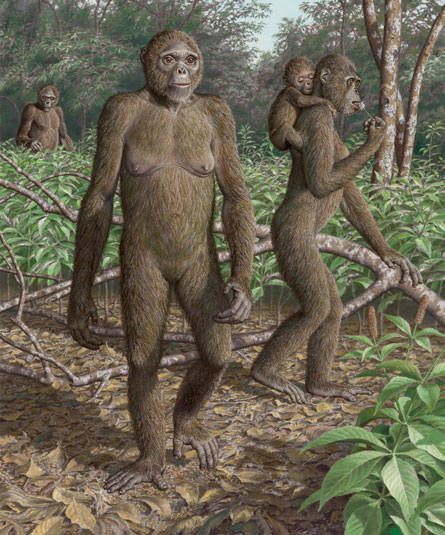
El primate en cuestión es el Graecopithecus freybergi. La especie se identificó en 1972 por von Koenigswald a partir de una mandíbula y tres piezas dentales encontrados en 1944 por tropas alemanas nazis en Pyrgos Vassilissis (noroeste de Atenas, Grecia). El fósil fue apodado “El Graeco”. Más tarde se identificó un premolar (RIM 438/387-P4), encontrado en Azmaka (Bulgaria) en 2009 (Spassov Nikolay, Denis Geraads, Latinka Hristova, Georgi Markov, Gildas Mereceron, Tzanko Tzankov, Krasimir Stoyanov, Madelaine Böhme, A Dimitrova, 2011), como perteneciente a esta especie. La antigüedad está datada en 7.24 (“El Graeco”) y 7.175 (diente de Azmaka) millones de años, a inicios del Messiniense (Fuss, Jochen; Spassov, Nikolai; Begun, David R; Böhme, Madelaine, 2017). En 2026 se encontró en Azmaka un fémur (FM3549AZM6) datado en 7,2 Ma, que parece corroborar el comportamiento locomotor complejo con evidencia de bipedismo en Graecopithecus.

Se ha vinculado directa o indirectamente con Graecopithecus las “huellas de Trachilos”. Encontradas en el pueblo cretense de Trachilos (al oeste de Kissamos, en la prefectura de Chania), se trata de un rastro de pisadas datadas en 5.7 millones de años (durante el evento llamado Crisis de Salinidad Messiniense o MSC), descubiertas por Gerard D. Gierliński en 2002. Las huellas, cuyas dimensiones son de 223 mm de largo por 94 mm de ancho, pertenecen a un primate bípedo y presentan una anatomía claramente comparable con la del pie de un Hominino. Las conclusiones evidentes de estos hallazgos es que existió en la Europa mediterránea, antes y también contemporáneamente con los Homininos de África Oriental, una población de primates muy similares a los ancestros de los humanos… o quizá son los reales ancestros de los humanos.
Fuss J, Spassov N, Begun DR, Böhme M (2017) Potential
hominin affinities of Graecopithecus from the Late Miocene of Europe. PLoS ONE
12(5): e0177127. https://doi.org/10.1371/journal.pone.0177127 Editor: Roberto
Macchiarelli, Université de Poitiers, FRANCE. Published: May 22, 2017
Jochen Fuss, Nikolai Spassov, David R. Begun, Madelaine
Böhme: Potential hominin affinities of Graecopithecus from the Late Miocene of
Europe Published: May 22, 2017. PLOS ONE
https://doi.org/10.1371/journal.pone.0177127
https://journals.plos.org/plosone/article?id=10.1371/journal.pone.0177127
Böhme M, Spassov N, Ebner M, Geraads D, Hristova L, Kirscher U, et al. (2017) Messinian age and savannah environment of the possible hominin Graecopithecus from Europe. PLoS ONE 12(5): e0177347. https://doi.org/10.1371/journal.pone.0177347 Editor: Roberto Macchiarelli, Université de Poitiers, FRANCE. Published: May 22, 2017
Madelaine Böhme, Nikolai Spassov, Martin Ebner, Denis
Geraads, Latinka Hristova, Uwe Kirscher, Sabine Kötter, Ulf Linnemann, Jérôme
Prieto, Socrates Roussiakis, George Theodorou, Gregor Uhlig, Michael
Winklhofer: Messinian age and savannah environment of the possible hominin
Graecopithecus from Europe. Published: May 22, 2017
https://doi.org/10.1371/journal.pone.0177347
https://journals.plos.org/plosone/article?id=10.1371/journal.pone.0177347
Graecopithecus freybergi: Oldest Hominin Lived in Europe, not Africa May 24, 2017 by News Staff / Source http://www.sci-news.com/othersciences/anthropology/graecopithecus-freybergi-hominin-04888.html
J. Fuss et al. 2017. Potential hominin affinities of Graecopithecus from the Late Miocene of Europe. PLoS ONE 12 (5): e0177127; doi: 10.1371/journal.pone.0177127
M. Böhme et al. 2017. Messinian age and savannah
environment of the possible hominin Graecopithecus from Europe. PLoS
ONE 12 (5): e0177347; doi: 10.1371/journal.pone.0177347
Hallan restos prehumanos de 7,2 millones de años en los Balcanes 22/5/2017 20:00 CEST https://www.agenciasinc.es/Noticias/Hallan-restos-prehumanos-de-7-2-millones-de-anos-en-los-Balcanes
THE SUN. THE WHOLE TOOTH Fossilised tooth said to be
7.2million years old may prove mankind came from Europe and not Africa- Neil
Syson 23 May 2017, 1:56 Updated: 23 May 2017, 10:54
Andrews, Peter; Franzen, Jens Lorenz, eds. (1984). The Early Evolution of Man: With Emphasis on Southeast Asia and Africa. Courier Forschungsinstitut Senckenberg, 0341-4116 69. Senckenbergische Naturforschende Gesellschaft. ISBN 9783924500054
Spassov Nikolay, Denis Geraads, Latinka Hristova, Georgi
Markov, Gildas Mereceron, Tzanko Tzankov, Krasimir Stoyanov, Madelaine Böhme, A
Dimitrova: A hominid tooth from Bulgaria: The last pre-human hominid of
continental Europe December 2011Journal
of Human Evolution 62(1):138-45 DOI: 10.1016/j.jhevol.2011.10.008 Source PubMed
Project: Miocene hominids from Europe
https://www.researchgate.net/figure/Map-of-Bulgaria-with-indication-of-the-locality-of-Azmaka_fig1_51863783
Gierliński, Gerard D. (October 2017). "Possible hominin footprints from the late Miocene (c. 5.7 Ma) of Crete?". Proceedings of the Geologists' Association. 128: 697–710 – via Science Direct
G. D. Gierlinski, et al. Possible hominin footprints from the late Miocene (c. 5.7 Ma) of Crete?. Proc. Geol. Assoc (2017), https://dx.doi.org/10.1016/j.pgeola.2017.07.006 Available from: https://www.researchgate.net/publication/319411867_Possible_hominin_footprints_from_the_late_Miocene_c_57_Ma_of_Cret
Huellas aparentemente humanas de hace 5,7 millones de años desconciertan a los científicos. José Manuel Nieves. 02/09/2017 https://www.abc.es/ciencia/abci-huellas-aparentemente-humanas-hace-57-millones-anos-desconciertan-cientificos-201709011308_noticia.html?fbclid=IwAR2gAZW4gaFB5rpK6x-DvJdu8YZxPX7Z2a9I9SuAXxAGbL0Vs965DtvnBjM#vca=rrss-inducido
https://nutcrackerman.com/tag/graecopithecus/
Spassov, N., Youlatos, D., Böhme, M. et al. Una forma temprana de bipedismo de homininos terrestres en el Mioceno tardío de Bulgaria. Palaeobio Palaeoenv (2026). https://doi.org/10.1007/s12549-025-00691-0
IMÁGENES:
Mapa: The jawbone, which included teeth, was unearthed in 1944 in Athens, Greece, while the tooth was found in Azmaka, south-central Bulgaria, in 2009 https://www.thesun.co.uk/tech/3625578/fossilised-tooth-said-to-be-7-2million-years-old-may-prove-mankind-came-from-europe-rather-than-africa/
Mandibula: The
jawbone, which included teeth, was unearthed in 1944 in Athens, Greece Credit: PA:PRESS ASSOCIATION
https://www.thesun.co.uk/tech/3625578/fossilised-tooth-said-to-be-7-2million-years-old-may-prove-mankind-came-from-europe-rather-than-africa/
This is the lower jaw of the 7.175 million year old
Graecopithecus freybergi (El Graeco) from Pyrgos Vassilissis, Greece (today in
metropolitan Athens). https://www.eurekalert.org/multimedia/pub/140913.php?from=359477
Diente: The tooth could be proof that modern man came from Europe Credit: PA:PRESS ASSOCIATION https://www.thesun.co.uk/tech/3625578/fossilised-tooth-said-to-be-7-2million-years-old-may-prove-mankind-came-from-europe-rather-than-africa/
This is a 7.24 million year old upper premolar of
Graecopithecus from Azmaka, Bulgaria CREDIT
Photo: Wolfgang Gerber, University of Tübingen https://www.eurekalert.org/multimedia/pub/140912.php
Reconstrucción: An artist's impression of what the landscape may have looked like when Graecopithecus roamed Europe Credit: REUTERS https://www.history.com/news/did-the-first-human-ancestor-emerge-in-europe-not-africa https://www.thesun.co.uk/tech/3625578/fossilised-tooth-said-to-be-7-2million-years-old-may-prove-mankind-came-from-europe-rather-than-africa/
Huellas: polémicas huellas descubiertas en Creta -
Andrzej Boczarowski
https://www.abc.es/ciencia/abci-huellas-aparentemente-humanas-hace-57-millones-anos-desconciertan-cientificos-201709011308_noticia.html?fbclid=IwAR2gAZW4gaFB5rpK6x-DvJdu8YZxPX7Z2a9I9SuAXxAGbL0Vs965DtvnBjM#vca=rrss-inducido
Un fósil hallado en los Balcanes muestra indicios de bipedismo y plantea nuevas preguntas sobre el origen humano. Recreación artística. Foto: ChatGPT-4o/Christian Pérez (Muy Interesante) https://muyinteresante.okdiario.com/historia/ancestros-humanos-balcanes-femur-bulgaria-bipedismo-evolucion.html
Graecopithecus freybergi vivió hace 7,2 millones de años en la sabana polvorienta de la cuenca de Atenas. Esta vista desde Pyrgos Vassilissis, lugar de su descubrimiento, se extiende hacia el sureste sobre la llanura de Atenas, bajo una nube rojiza de polvo del Sahara; al fondo: los montes Himeto y Licabeto. Crédito de la imagen: Velizar Simeonovski. https://www.sci.news/othersciences/anthropology/bipedal-graecopithecus-14605.html#google_vignette
Figuras 1a y 1b de Fuss et al. 2017, que muestran especímenes de Graecopithecus . Leyenda original: a, Mandíbula tipo de G. freybergi de Pyrgos, Grecia. b, RIM 438/387 – P4 izquierda de cf. Graecopithecus sp. de Azmaka, Bulgaria. De izquierda a derecha: distal, mesial, lingual, bucal, oclusal y apical. https://www.johnhawks.net/p/graecopithecus-fuss-2017


Comentarios
Publicar un comentario